
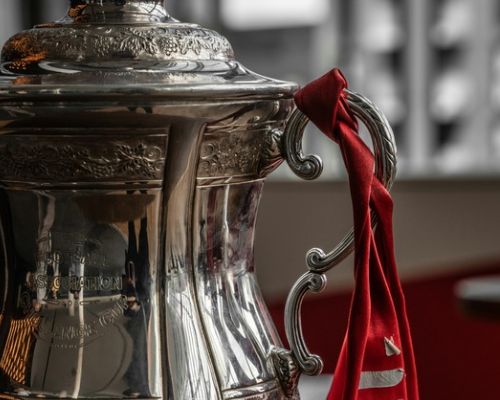
Stan Mortensen’s free kick in 1953 is still the only hat-trick goal in an FA Cup Final at Wembley, but that may not be the strike’s only milestone.
The FA Cup returns
The Emirates FA Cup First Round proper took place this weekend, marking the start of the 146th campaign of the oldest tournament in world football.
The competition has been pivotal in the game’s development, from regulations and technology to its global growth, capturing the imagination of millions of football fans.
Over the last few days, several non-league clubs aimed to defy the odds against some of England’s fully professional teams. Seventh-tier Wimborne Town stole the headlines with victory over League Two’s Crawley Town, and Kidderminster Harriers from the National League put three past League One’s Doncaster Rovers with no reply, adding to the archives of memorable stories from the FA Cup.
A highlight from the ages
Talking of remarkable moments, 2027 will mark 74 years since one of the most storied finals in the FA Cup’s long history.
Dubbed the ‘Matthews Final’ after a dazzling display by England star Stanley Matthews, Blackpool came from behind to defeat Bolton Wanderers 4-3 at the old Wembley Stadium in 1953.
But Matthews, who later became the first Ballon d’Or winner in 1956, was not the only star of the show in a Tangerine shirt. Teammate and striker Stan Mortensen netted three of Blackpool’s goals, with his third coming from a direct free kick.
Shaping free kicks of the future?
Mortensen’s free kick remains the only ever hat-trick goal in an FA Cup Final at Wembley Stadium, but that may not be the only milestone that can be attributed to this set piece.
Archive video published by British Pathé shows Mortensen blasting the ball past a five-man Bolton defensive wall, before it crashes into the top corner to level the score at 3-3 in the 89th minute.
Seven years prior, in the final of 1946, Bert Turner’s free kick for Charlton Athletic deflected off a Derby County defender and into the net, but footage appearing to show a lack of defensive wall.
Mortensen’s screamer could therefore be one of the oldest videos of a free-kick goal scored against a defensive wall, and perhaps it was the first in an FA Cup Final.
Will we see more free-kick goals?
Fast forward to modern day, and the defensive wall is now a common – and quite necessary – defensive tactic, required to be at least 10 yards (9.15 meters) away from the ball at the point of the foul.
In a first of its kind, the LAZRSpray device is designed to quickly and reliably measure the ball-to-wall distance for referees, helping them position the defensive wall as per IFAB’s Law 13.2.
The device was created after a study on vanishing spray in the German Bundesliga revealed that the ball-to-wall distance is subject to inaccuracies without a definitive measuring tool.
By utilizing the LAZRSpray, and being able to ensure this distance is the same in every free-kick scenario from the training ground to competitive matches, the chances of players scoring directly from the set piece could increase.
Could we see more iconic free kicks scored in the FA Cup in years to come? Only time will tell.