
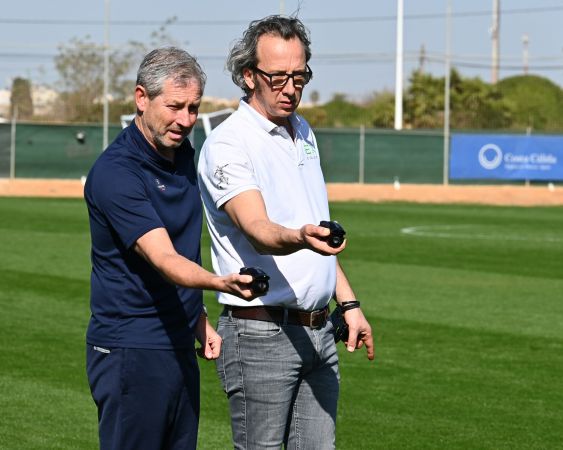
Frank De Bleeckere and Raf Bogaerts demonstrating the LAZRSpray.
From residential roofs to the football field, Raf Bogaerts has used his experience developing niche technology to help prevent misplaced free-kick walls.
The FIFA World Cup has often been a hotbed for technology innovations receiving widespread attention across the global game, and this year’s competition was no different.
From goal-line technology and VAR to the AI-powered footballs and post-match analysis implemented in North America this summer, technology in football – or the need for it – has always sparked intrigue and conversation among fans, pundits, and professionals.
Despite tech’s growth in sport being inevitable, the fans’ passion still lies in football’s purest values that stretch back well over a century. Competition. Rivalries. Communities. It’s a language that is understood all over the world.
With that in mind, LAZRSpray set out to solve a problem in the sport, developing an innovative gadget that brings subtle change and real benefits to the game we love.
The device uses optical time-of-flight rangefinder technology to help referees quickly and accurately measure the ball-to-wall distance during free kicks. This is inspired by a study in the German Bundesliga that showed manual measuring can result in unintentional inconsistent application of IFAB’s specified distance of 9.15 meters or 10 yards – or, in other words, walls that are too close to or too far away from the ball.
The game is already very familiar with the vanishing spray foam that stops the wall encroaching on this distance, after the canister captured worldwide attention 12 years ago at the FIFA World Cup in Brazil.
Fast forward to today and, despite being used approximately four times per match, the spray goes largely unseen. It’s part of the furniture, and it’s important that it stays that way even with the addition of LAZRSpray.
Enter the picture, Rag Bogaerts from Expo-Line, who has been UEFA’s official supplier of vanishing spray since 2014. He collaborated with the LAZRSpray team to help shape the device into a product that complements what is already commonplace in today’s game.
“We have experience with referees – what they face in match conditions, and certainly in those match situations where a free kick is taken” explained Bogaerts, who has worked directly with football federations and elite match officials for more than a decade.
“The LAZRSpray landed on my desk four years after our vanishing spray really took off at UEFA Euro 2016 in France. In between, we had already searched for other technologies because we saw the next step was getting the right distance.
“I responded to Tom [Beaumont, LAZRSpray founder] because I wanted to know more, because we see that there is an issue and there needs to be a solution for that.
“If you add a new layer [to the referee’s processes], then you increase the stress because you take more focus [away] from the referee – who needs to be focused on many things at that moment. They need to manage the game, and they need to make the right decisions on the spot.
“They are already used to using the vanishing spray; there is nothing changing. My approach is always to keep it simple: the power of a product is its easiness to use.
“With all the technologies that I’ve seen between the launch of our vanishing spray and the LAZRSpray, this was the most simple and effective.
“It’s easy to use, it’s intuitive to use, and with other technologies there is always some sort of interpretation of a tool. But with this there is no interpretation – it is 9.15 [meters] or it isn’t. It’s clear [and] you see it on the screen.”
While a laser-based measuring device would be a world first on the football field, this is far from Bogaerts’ debut in creating tangible technology that is designed to be so effective it almost becomes invisible.
His experience here predates the vanishing spray by two decades, because back in 1994 he developed a revolutionary product that helped football field lines transition from powder to paint.
“In the late 1980s, there were a lot of burn injuries caused by the powder chalk they used, so could we bring a solution to that? That’s when we kicked off with developing a coating for line marking in football. Nobody was doing it.
“We come from a coating business, so we – my brother and I – set up an enterprise that came onto the market offering niche products for roofs. Then we developed a coating to clean the walls of squash courts, because you can’t use water on the wood, and that was our first step into sport.
“Sport has always been very important to me. I did a lot of sports in my youth, from tennis to surfing to football, and I had a very good kick. But unfortunately, my parents were against me going into football because they said it was too dangerous.
“So, we followed football a lot in those early years and the years after that, but we always stood a bit at the sides. We tried to look to the pitch, to sports, from our point of view. Where can we bring added value? Where can we improve it?
“We are now at the Champions League level at this point, not directly in the game, but with the products that we develop.”
The LAZRSpray is the latest idea to enter through the doors at Expo-Line and exit as a physical product ready for application, along with support from other leading tech companies such as innove SA who built the device’s performance tracking system.
This technology provides referees and trainers with metrics to specifically measure performance of officials in matches and during practice.
“At this moment in time, referees use the same technology as footballers to get their position. But with 22 EPTS [Electronic Performance Tracking Systems] devices already being analyzed on the same field, what we see is that some of the EPTS devices can disturb each other in accuracy.
“The info we get out [of the LAZRSpray] is specifically on referees; heart rates, accelerations, decelerations, the running tracks, and so on. The coaches and the referee can analyze their own results after a game and after training.
“In every decision, they need to be not far off the ball, to have a good eye on the ball, to get their decision sold to the world of football. They need to be very sure of every decision they make.
“Another thing is, we collect the data from all the uses of the LAZRSpray during the match, such as the on-field positions and distances measured. The referees have the reports such as how many of their steps are 9.15 meters.
“Since the first time that I used a LAZRSpray, I have adapted my steps without knowing it. I am convinced if referees train on taking the steps using the LAZRSpray they will automatically in the game be more accurate with their steps.”
With his knowledge of the device and match officiating, having established the Expo-Line Referee College, Bogaerts has been a key figure in testing the LAZRSpray alongside retired FIFA official Frank De Bleeckere and current international referee Lawrence Visser.
The device’s development has been a large collaborative effort across the football and electronics industries, and the overriding consensus from the officiating community has been very positive.
“The Referee College has supported various referee education and development activities, often in collaboration with the Royal Belgian Football Association,” added Bogaerts. “These experiences played an important role in shaping our understanding of what referees truly need from any support tool.
“While Expo-Line contributed years of practical experience from football and refereeing environments, Tom and the LAZRSpray team deserve enormous credit for the continued development of the technology itself and for their willingness to keep refining the product based on real-world feedback.
“One of the key strengths of LAZRSpray has always been this combination of technology development and practical referee experience.
“The product was not developed in isolation, but through an ongoing collaboration focused on creating something that is simple, intuitive, and genuinely useful for match officials.”